Going Bare Metal
How we cut our CI bill by 4x with 32 rented servers

The last few years have been very eventful in the software engineering world, and so were our CI costs: they skyrocketed from a steady €2,000 a month to a whopping €13,000 in the span of three months.
As in many companies, our software engineers ship far more than they used to (more on how in this post). That brings a whole lot of challenges, one of them being a CI that just can't keep up anymore.
So we decided to move our CI to bare metal. Yes, in 2026, when cloud-first is the default, renting servers and managing them ourselves sounds like a step backwards. Here's why it wasn't.
The problem
Almost all CI providers use shared runners by default. They're convenient: they're already set up in a sound way, and running your first tests is just a matter of writing your CI manifests.
But this convenience comes at a price.
We feel it when America wakes up
CI providers try to maximize the usage of their compute resources by bin-packing as many workloads as possible. It makes sense: they want to buy as little hardware as possible and run as many CI pipelines as possible on it, to maximize their profit.
For customers, the net effect is what's called "noisy neighbors": you share the processing power with other companies, and your CI jobs' performance depends on how busy your neighbors are.
Orus is a French company, based in Paris. A lot of the tools we use (e.g. GitHub Actions, Blacksmith) are built in the US.
Guess what? We notice when America wakes up. From around 3 p.m. Paris time, when the East Coast comes online, until the West Coast logs off in the middle of our night, our jobs are about 30% slower.
And because we pay by the minute, they're not only 30% slower, they're also 30% more expensive. CI providers have no incentive to fix this.
Tests are flakier than ever
Noisy neighbors impact a lot of things: the network gets less stable, the CPU stalls for longer, and integration and E2E tests get flakier than ever.
It's expensive!
€0.008/min doesn't sound like a lot. But when you have 20 developers and 150 E2E tests, split across seven 4-core runners that run for 18 minutes, it gets expensive fast:
We run the tests on every commit pushed to a PR, then again in the merge queue to avoid semantic conflicts, and one last time on main to catch flaky tests.
Now picture 5 PRs per dev per day, with 20 devs, and watch the bill snowball:
I don't think these figures are out of this world. In my opinion, they're consistent with a scale-up. Sure, we could argue there are optimizations to make, or that €13,000 isn't that much for a scale-up raising dozens of millions of euros. But we were convinced we could do better.
Going bare metal
We asked ourselves: "What if we rented the hardware ourselves?" It could only be cheaper, but how much cheaper?
We went hunting for the best bare-metal servers we could find. Our criteria were simple:
- At least 8 cores and 16 threads, to fit our biggest jobs
- A vCPU/RAM ratio of 1:4: 2 vCPUs get 8 GB of RAM, 4 vCPUs get 16 GB, and so on
- At least 512 GB of disk
- Unlimited 1 Gbit/s bandwidth
- A gaming-class CPU, as our workloads are mostly CPU-bound
And we found our sweet spot: the OVHcloud RISE-S, a beefy machine for €78/month, VAT included. We rented 32 of them, for a total of €2,500/month. As a bonus, OVHcloud is a French company 🇫🇷, just like us, so our CI now runs close to home. There's also a one-time setup fee equal to one month of rent, so another €2,500 once. Even with the CI orchestrator's own fee on top (more on that below), the savings pay that back in about a week.

Renting servers is the obvious middle ground: you don't have to maintain the hardware, you get a great network backbone, and any provider worthy of the name has monitoring in place to detect failing machines.
Here's our fleet. And yes, each server is named after a dinosaur (plus one pterosaur, for the purists).
Orusaurus, our AI reviewer, finally has some company. 
- acro: Acrocanthosaurus
- allo: Allosaurus
- amarga: Amargasaurus
- anky: Ankylosaurus
- bary: Baryonyx
- brachio: Brachiosaurus
- bronto: Brontosaurus
- carno: Carnotaurus
- cerato: Ceratosaurus
- compy: Compsognathus
- deino: Deinonychus
- dilo: Dilophosaurus
- dryo: Dryosaurus
- galli: Gallimimus
- giga: Giganotosaurus
- hadro: Hadrosaurus
- igua: Iguanodon
- kentro: Kentrosaurus
- lambeo: Lambeosaurus
- maia: Maiasaura
- mega: Megalosaurus
- nodo: Nodosaurus
- ovi: Oviraptor
- pachy: Pachycephalosaurus
- para: Parasaurolophus
- plateo: Plateosaurus
- ptero: Pteranodon
- raptor: Velociraptor
- rex: Tyrannosaurus rex
- spino: Spinosaurus
- stego: Stegosaurus
- tarbo: Tarbosaurus
Maintaining such a fleet: a DevOps nightmare?
Managing a 32-server fleet when you're used to cloud offerings sounds like a full-time job requiring a dedicated SRE team 24/7. You instantly think Debian, SSH hardening, firewalls, unattended upgrades, Ansible...
But it's 2026, and there are now alternatives that are way easier to maintain. At Orus, we use immutable, image-based systems, both built with bootc and with Talos. We'll focus on Talos here, as it's tailored for clusters, and more specifically Kubernetes clusters.
Talos Linux

Talos Linux is an immutable, API-driven OS for Kubernetes.
It's secure by default: there's no SSH access, only an API endpoint meant to be used with the talosctl CLI.
Being immutable means system files can't be changed at runtime: every change goes through a system upgrade.
Bootstrapping a cluster and adding nodes is very simple with TOPF, the Talos orchestrator open-sourced by PostFinance. The whole cluster fits in a single manifest:
---
clusterName: orus-ci
clusterEndpoint: https://k8s.ci.example.com:6443
kubernetesVersion: 1.37.2
talosVersion: 1.14.6

schematicId: "@schematics/amd-worker.yaml"

# Our own small binary, which pulls the cluster secrets from 1Password
secretsProvider: topf-secrets-1password

# Per-model node data, merged into a node's data with `<<:` (keys set next to
# it add to or override it).
x-rise-s: &rise-s { provider: ovh, location: france-gravelines, cpu: amd-ryzen-7-9700x, cores: 8, threads: 16 }

nodes:
  - host: micro
    ip: 192.0.2.2 # Example IPs
    role: control-plane
    data: { <<: *rise-s }

  - host: dimorpho
    ip: 192.0.2.3
    role: control-plane
    data: { <<: *rise-s }

  - host: tapeja
    ip: 192.0.2.4
    role: control-plane
    data: { <<: *rise-s }

  - host: galli
    ip: 192.0.2.5
    role: worker
    data: { <<: *rise-s }

  - host: igua
    ip: 192.0.2.6
    role: worker
    data: { <<: *rise-s }
Armed with that, adding a new server is a matter of booting it from a .qcow2 image URL (here, the image built from our AMD schematic) and running a single CLI command. The server then joins the cluster automagically!
Updating is just as easy: bump the version in the manifest, run a single CLI command, and you're done.
Kubernetes
Kubernetes is a great fit for CI. Pipelines have different CPU and RAM needs, and Kubernetes excels at allocating resources fairly across the available workers.
It also makes it easy to declare things that must run on every node (e.g. Docker caches, Git mirrors, monitoring) with a DaemonSet.
And our developers already know Kubernetes, since we use it in production for the Orus application, so the cluster is easy to maintain.
Buildkite
The last piece is the CI orchestrator. We use Buildkite, which is built around bringing your own compute: Buildkite hosts the pipelines, the UI and the job queue, and our cluster runs the jobs. Its Kubernetes agent stack picks up each job and runs it as a pod, with the CPU and RAM the job asked for.
Buildkite isn't free, though: with our concurrency and number of users, it costs us about $1,000 (around €900) per month.
The downsides
Bare metal isn't a free lunch. Compared to a managed CI provider, there's:
- More infrastructure to update: Talos, Kubernetes, and everything running on the cluster
- Base CI images to maintain, with all the tools our jobs need (bash, curl, etc.), where shared runners ship them out of the box
- More configuration to own
It sounds like a lot, but in practice we've probably been investing 1 hour per week maintaining it. And that gets even easier with AI agents.
The other catch is that our compute isn't infinite anymore. Blacksmith would happily spin up as many runners as we asked for (and bill us for every one of them). Our cluster has 512 threads, and not one more. A slow or bloated pipeline doesn't just cost more: it takes capacity other jobs need, and PRs start waiting in the queue. So optimizing our pipelines went from a nice-to-have to a must.
The results
The results have exceeded our expectations. Our CI bill went down from €13,000 to about €3,400 per month: €2,500 for the servers, plus around €900 for Buildkite.
Speed-wise, our jobs are as fast as they were on Blacksmith (known to be among the fastest CI runners) when the US is asleep. Except now, it's like that at any time of day. And our CI is rock stable, because we don't have any noisy neighbors anymore.
Our CI used to be fast only while America slept. Now it's fast all day.
Our current fleet also runs with a 20% capacity buffer, so a busier-than-usual day doesn't leave jobs waiting in the queue. And when we outgrow it, scaling is as easy as adding worker nodes: rent another RISE-S, add it to the manifest, run a single command, and it joins the cluster.
There are also nice bonuses to having dedicated servers. We now have full control over our machines, which lets us hook into deep parts of the system. For example, every job produces this HTML report:
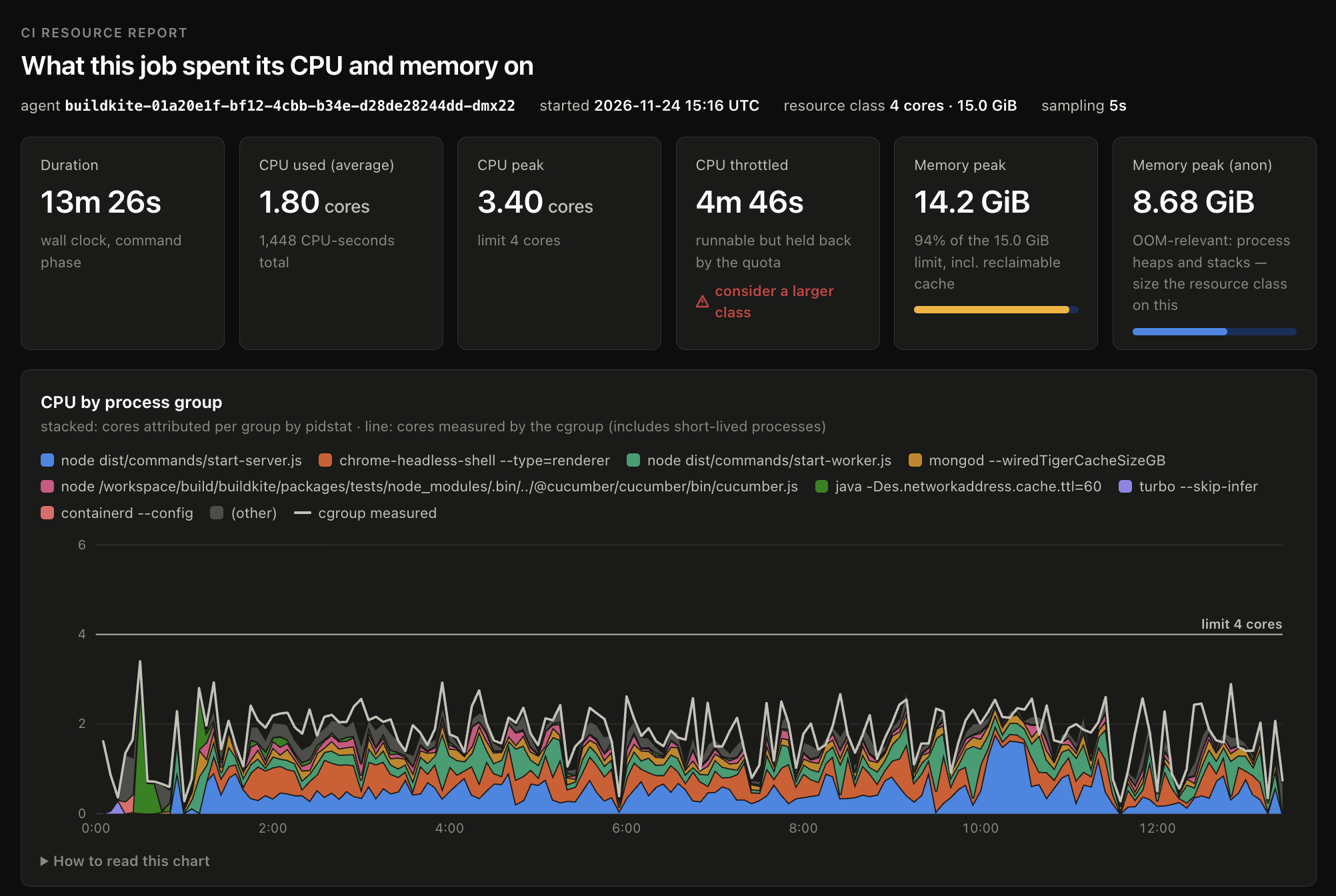
Hard to believe, I know, but Claude wrote the generator for these reports.
Debugging and optimizing CI jobs is way easier with this kind of report at hand.
Free night capacity
Our CI pipelines are mostly active during the day. Now we have resources sitting idle at night, and using them is basically "free" since we aren't billed by the minute. Having 512 gaming-class CPU threads and 2,048 GB of RAM available 12 hours a day is a nice bonus, right?
One of the ways we use this capacity is to stress our E2E tests to detect the flaky ones. More on that in an upcoming blog post. 😉
That's it for this article! I hope our experience helps you decide whether bare metal is worth it for your own CI.
Don't hesitate to reach out to me on LinkedIn if you have any questions or feedback, and I'll gladly reply!

Like the way we think?
We're based in Paris and we're hiring software engineers.